
Someone asked me how old I was last week. I said 35. Then I checked. I was 35 years, 9 months, 25 days, 3 hours, and 17 minutes old. Not "35." The difference matters more than you think.
The problem with "I'm X years old"
When someone asks your age, you round down. Everyone does. But that rounding hides real data. Insurance companies don't round; they bill to the day. Immigration offices calculate visa durations in exact days. Pediatricians track developmental milestones in weeks. Pension systems compute benefits down to the month.
The Korean age system adds another layer: you're 1 at birth and gain a year every January 1st, not on your birthday. South Korea officially switched to international age in June 2023, but the cultural system persists.
Your age isn't a single number. It's a vector: years, months, weeks, days, hours, minutes. Each component matters in different contexts.

The math is simple; the edge cases aren't
Calculating the difference between two dates sounds trivial. Subtract one from the other, divide by 365.25. Done. Except it isn't.
naive_age = (today - birthdate) / 365.25
This gives you a decimal. 35.818. What does that even mean? The .818 of a year is 299 days, but that doesn't tell you months and weeks in a way humans understand.
The real calculation needs to handle:
- Leap years. February 29 births only have a "real" birthday every 4 years. The legal birthday varies by jurisdiction; in the UK it's March 1 in non-leap years, in New Zealand it's February 28.
- Month length variation. January 31 to February 28 is "one month" even though it's only 28 days. August 31 to September 30 is also "one month" but it's 30 days.
- Time zones. If you were born at 11:50 PM in Tokyo and it's currently 1 AM in London, the naive date math could be off by a day.
- Negative months. If your birthday is March 31 and today is April 30, the month difference is 1 but the day difference is 0 (not -1).
None of these are hard individually. Together they produce enough friction that most people just say "35" and move on.
Why I built a precise age calculator
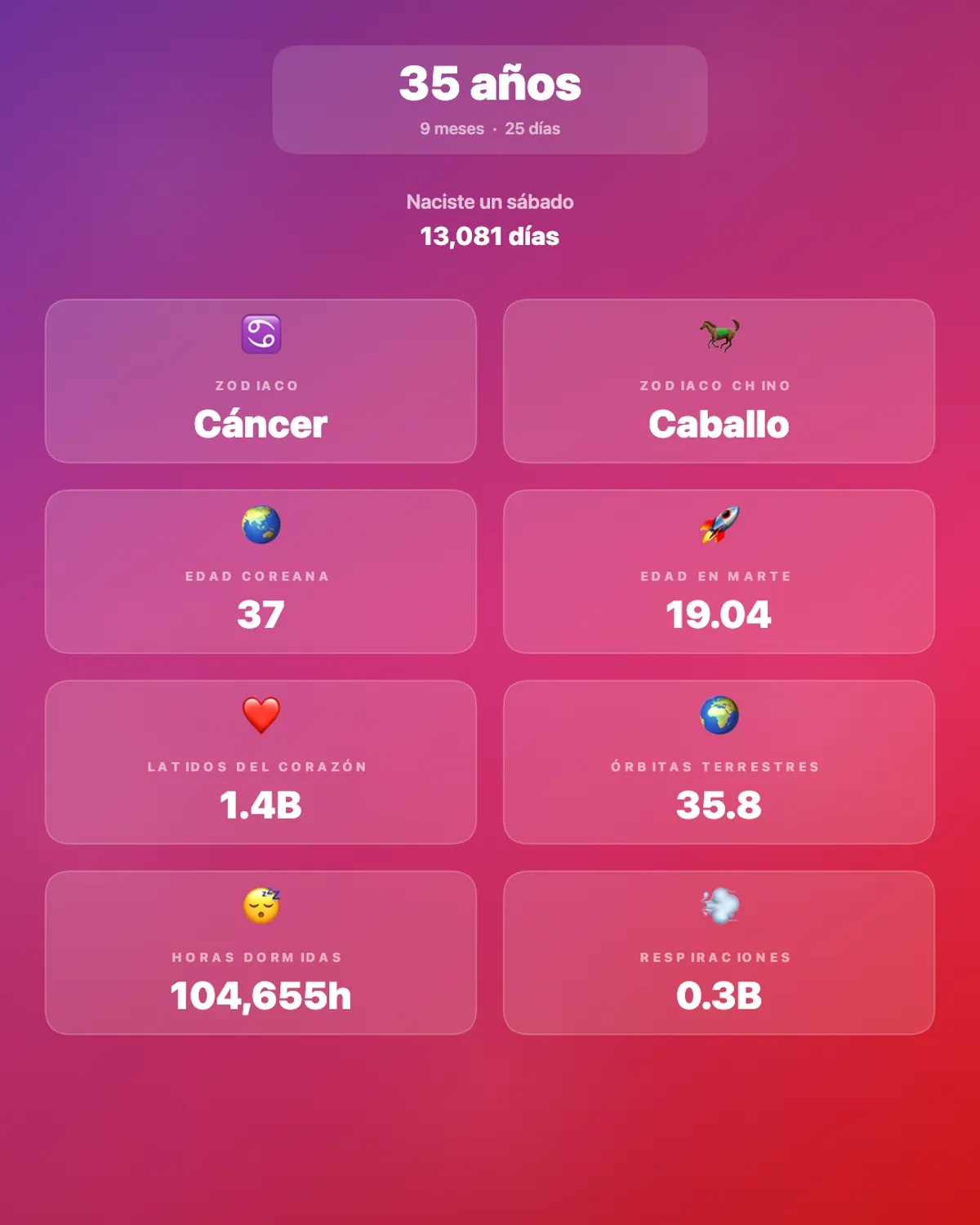
I was working on a date difference calculator and realized the same engine could power an age calculator with richer output. Instead of just "X days between two dates," it could show:
- Exact age in years, months, days
- Total weeks lived
- Total hours and minutes
- Day of the week you were born
- Your Western zodiac sign
- Your Chinese zodiac animal
- Your Korean age
- Days until your next birthday
The Age Calculator runs entirely in the browser. Enter a birthdate, optionally a target date, and it computes everything instantly. No server, no signup, no data leaves your device.
Practical uses beyond vanity
The "how old am I" query is consistently popular on Google Trends. Most of those searches aren't vanity; they're functional.
Legal and administrative. Age verification for contracts, voting eligibility, retirement dates. Many countries have age-based legal thresholds: 18 for voting, 21 for alcohol (US), 65 or 67 for pension. Knowing your exact age to the day determines whether you qualify today or need to wait.
Health and fitness. Age is the primary input for BMR calculators, body fat estimators, and VO2 max charts. A 35-year-old and a 36-year-old have different baseline metabolic rates. Using the wrong year skews your calorie targets.
Immigration. Visa applications often require "age at time of application" computed to the exact day. The USCIS uses age-at-filing to determine eligibility for certain categories. Getting it wrong means a rejected application.
Education. School cutoff dates vary by district. A child born on September 1 vs September 2 can end up in different grades for their entire academic career. Parents use exact age calculations to determine kindergarten eligibility.
Genealogy. If you're tracking family history with a date calculator or business days calculator, exact age at historical events adds context that rounded years miss.

Korean age, Western age, and the confusion
Until June 2023, South Korea had three age systems running simultaneously:
| System | How it works | A person born Dec 31, 2000 on Jan 1, 2026 |
|---|---|---|
| International | Birthday to birthday | 25 years old |
| Korean (traditional) | 1 at birth, +1 on Jan 1 | 27 years old |
| Year-counting (연 나이) | Current year minus birth year | 26 years old |
The Korean Age Calculator in our tool shows both international and Korean age. The gap narrows to 1 year after your birthday in any given year and widens to 2 years before it.
This isn't just trivia. If you're doing business in Korea, understanding which age system someone is referencing avoids awkward miscommunications. "I'm 27" from a Korean colleague born in 1999 means they're 25 or 26 internationally.
Days until your next birthday
A small detail I added: the tool shows how many days remain until your next birthday. It accounts for leap years properly; if your next birthday falls on Feb 29 in a non-leap year, it calculates the distance to Feb 28 or March 1 depending on convention.
This pairs well with a countdown timer if you want a live ticker, or a week number calculator if you're tracking "birthday week" for planning.
What your zodiac sign actually means (computationally)
The tool calculates both Western and Chinese zodiac. Western is based on your birth date falling within one of 12 date ranges (Aries: March 21 to April 19, etc.). Chinese is based on the lunisolar calendar; the animal cycles every 12 years, but the exact cutoff depends on the Lunar New Year date for your birth year.
2024 was the Year of the Dragon. 2025 is the Snake. If you were born in late January or early February, the calculation isn't as simple as birth_year % 12; you need to check whether you were born before or after the Lunar New Year.
Your age on other planets
One of the features I like most: the calculator also shows your age on Mercury, Venus, Mars, Jupiter, and Saturn. It's not a gimmick; it's straightforward orbital mechanics.
Each planet has a different orbital period; the time it takes to complete one lap around the Sun. Your age in "Earth years" only measures how many times Earth orbited the Sun since you were born. On a planet with a shorter orbit, you've completed more laps. On a slower one, fewer.
For someone born on June 23, 1990:
| Planet | Orbital period (Earth days) | Your age |
|---|---|---|
| Mercury | 87.97 | 148.7 years |
| Venus | 224.7 | 58.2 years |
| Earth | 365.25 | 35.8 years |
| Mars | 687.0 | 19.0 years |
| Jupiter | 4,333 | 3.0 years |
| Saturn | 10,759 | 1.2 years |
On Mercury you'd be nearly 149. On Saturn you'd barely be a toddler. The numbers are a good reminder that "age" is relative to the clock you choose; and on Earth, we chose one particular orbit without thinking much about it.
The Age Calculator computes all five planetary ages automatically. It also shows cosmic statistics like estimated heartbeats, breaths taken, and hours slept; fun data points that put a 35-year life into physical perspective.
Technical notes
The calculator is built with React and TypeScript. All computation happens client-side using JavaScript's Date API with manual adjustments for edge cases (leap year February birthdays, month-boundary crossover). No moment.js or date-fns; the logic is custom and lightweight.
The URL state is shareable; bookmark your birthdate and you can check your exact age on any device without re-entering it.
Try it
The Age Calculator is free, private (no data sent anywhere), and handles the edge cases that spreadsheets and mental math don't. If you're curious about the other datetime tools, the Unix timestamp converter, leap year checker, and seconds-to-HMS converter are part of the same datetime toolkit.
Enter your birthdate. The number might surprise you.
All calculations run locally in your browser. No data is sent anywhere. The tool is free, open, and has no accounts or limits.