
A few months ago I sat in a PI planning session where a team of twelve argued for forty minutes about whether a "see product alternatives" button was more important than a "notify me" button for out-of-stock items. Both PMs had slide decks. Both had data. Both were convinced. The conversation ended the way those conversations always end; the loudest person in the room won, and everyone else went back to their laptops with a quiet grudge.
That meeting is why I rebuilt our WSJF Calculator. Not because the world needed yet another backlog prioritization tool, but because I kept watching smart teams flush an entire quarter down the drain arguing about feelings when the math has existed since the 1980s.
The trick nobody tells you about prioritization
Most people think prioritization is about picking the most valuable thing. It isn't. It's about picking the thing where value divided by size is highest. That distinction sounds pedantic until you realize it's the difference between shipping eight small wins in a quarter and shipping one lumbering "strategic initiative" that nobody really wanted.
That's the whole thesis behind Weighted Shortest Job First. You score each backlog item on two things; how expensive it is to delay, and how big the job is. Then you divide. The highest score wins. That's it. No story point debates at 9am on a Monday, no "is login page a 3 or a 5", no pretending your gut feeling is a methodology.
WSJF = Cost of Delay / Job Size
Don Reinertsen popularized this in The Principles of Product Development Flow, which I'd call the best agile book ever written if the phrase "agile book" didn't immediately make most engineers reach for the nearest window. It's actually a queueing theory book dressed up as a management book, which is why it's so good.
Cost of Delay is three things, not one
Here's where most WSJF spreadsheets get it wrong. Cost of Delay isn't a single number. It's the sum of three very different questions:
- Business Value. If we shipped this tomorrow, how much would users or the business care? Revenue, retention, a specific OKR. Concrete when you can, relative when you can't.
- Time Criticality. Does the value decay over time? A Black Friday feature shipped in December is worth approximately zero. A compliance deadline you miss is worth less than zero.
- Risk Reduction / Opportunity Enablement. Does this unlock something else, or take uncertainty off the table? Boring infrastructure work lives here and that's usually where it gets buried.
Add those three together. That's Cost of Delay. Divide by Job Size. That's WSJF. The reason this works isn't because the numbers are accurate; it's because the conversation is accurate. You can't pretend a risk-reduction spike is a revenue feature anymore. Every item has to justify itself on three axes before it gets a score.
Why relative sizing beats hours every single time
The other trap is how you size. People want to estimate in days. Don't. Human beings are terrible at estimating duration and we have decades of behavioral research showing it; Parkinson's law alone should be enough to scare you off. What humans are actually okay at is comparing two things and saying "that one's bigger."
So score in Fibonacci (1, 2, 3, 5, 8, 13, 20) or T-shirt sizes (XS, S, M, L, XL, XXL). The gaps matter; a jump from 5 to 8 forces a conversation that "4 days vs 5 days" doesn't. Our tool supports both because teams argue about this, and the argument is not worth having. Pick one. Move on.
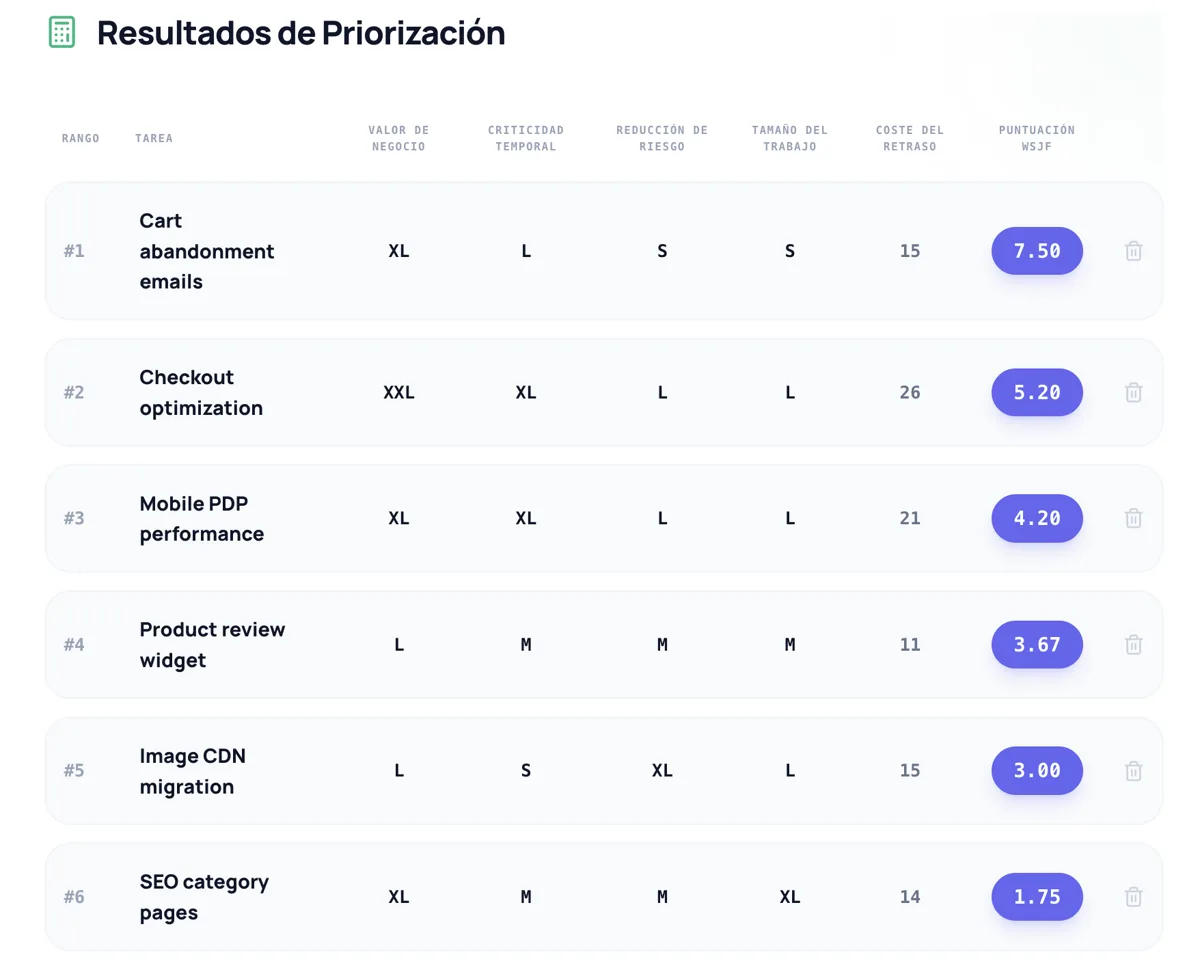
What the tool actually does
The WSJF Calculator runs in your browser. Nothing leaves your machine. I'm obsessive about this for product-management tools specifically; your roadmap is the kind of thing you really don't want sitting on someone else's server.
Here's what we built into it after watching teams actually use it:
- Templates for common domains. E-commerce, SaaS, internal platform, regulated industry. Start from something that already makes sense.
- What-if analysis. Inflate the top task's size by 25%. Does the ranking flip? If yes, your top priority is fragile; re-estimate before you commit.
- Robustness indicator. If the top three WSJF scores are within 10% of each other, treat them as equal and let team capacity decide. The tool shows you this in real time so you stop pretending 4.20 is meaningfully bigger than 4.10.
- Share links. Copy a URL, paste it in PI planning notes, everyone loads the same backlog state. No Jira exports, no CSVs floating around Slack.
- CSV + PDF export. Because some stakeholders only trust a PDF.
When WSJF is the wrong answer
I'll save you a mistake I've made. WSJF is not a universal prioritization framework. It's the right tool when:
- You have 15 or more roughly comparable backlog items.
- Your team is doing continuous delivery with short cycles.
- Cost of delay is actually variable across items (some are time-sensitive, some aren't).
It's the wrong tool when:
- You have a single strategic bet and three support tickets. Just do the strategic bet.
- Everything is equally urgent. Then nothing is, and you have a management problem, not a prioritization problem.
- You're trying to decide between two products. That's a Kano or portfolio question.
For binary in/out decisions, reach for MoSCoW or the Eisenhower matrix instead. For consumer-product feature ranking where you want a simpler formula, RICE is friendlier. I built versions of all three; they each solve a slightly different shape of problem.
The meeting ritual that actually works
WSJF breaks down when it becomes a ritual. The calculator does the math; the humans have to do the talking. Here's the loop I've seen work:
- Score Cost of Delay first, together. Use planning poker to surface disagreement. If two people scored a 3 and a 13, that's interesting; dig in.
- Score Job Size last. If you know the size first, it anchors the value estimate. Humans are lazy that way.
- Read the top three out loud. If anyone flinches, re-score.
- Lock and ship. Don't re-score mid-sprint. The whole point is that yesterday-you and today-you had different gut feelings but the math didn't move.
For longer-horizon commitments, pair WSJF with probabilistic forecasting. I wrote a whole piece on Monte Carlo delivery forecasting that pairs nicely with this; one tool tells you what to do next, the other tells you when you'll realistically be done.
The part that surprised me
When I first shipped the calculator, I expected engineers to use it. It turned out product managers are the heaviest users, and the thing they love most isn't the score. It's the audit trail. Every ranking has the three sub-scores visible; when a stakeholder asks "why isn't my feature at the top", the PM can point at a number and say "because your Time Criticality is S and your Job Size is XL." The conversation ends in a minute, not a week.
That's the real point of any prioritization tool. Not to replace judgment. To make judgment visible enough that the loudest person in the room can't overwrite everyone else.
Try it here: kitmul.com/en/agile-project-management/wsjf-calculator. It's free, it's in your browser, and your backlog is still yours.