Last Tuesday my friends spent 14 minutes deciding where to go train. Fourteen minutes. Four of us, three opinions about that rooftop downtown, one person who wanted the park with the low walls, and nobody willing to commit because nobody wanted to be the one who picked wrong.
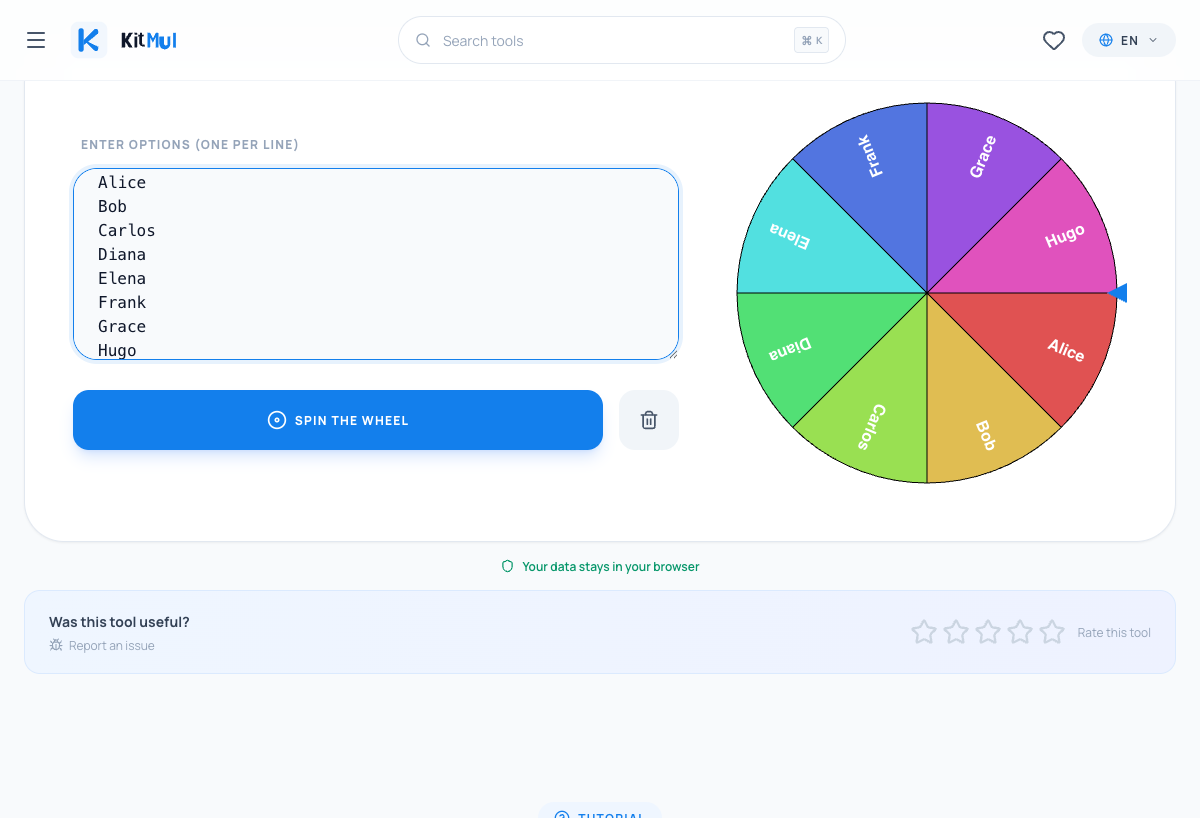
I opened a browser tab, typed six parkour spots into a spin the wheel tool, and hit spin. The wheel landed on the bridge underpass. Everyone shrugged. We went. The session was solid. Nobody complained.
That 14-minute argument wasn't about training spots. It was about decision fatigue; the slow erosion of your ability to make good choices after making too many mediocre ones. And it happens constantly in contexts far more consequential than where to practice your kongs.
Why humans are terrible at random selection
We think we're good at picking things randomly. We're not. Ask someone to pick a random number between 1 and 10, and they'll disproportionately choose 7. Ask a teacher to cold-call students "randomly" during class, and they'll unconsciously favor the kids who make eye contact, sit up front, or haven't been called recently. The bias is invisible to the person doing the picking.
This isn't a character flaw. It's architecture. Human brains evolved to find patterns, not to generate randomness. A study published in PLOS ONE showed that when people try to produce random sequences, they systematically avoid repeats and clusters; the exact features that genuine randomness produces. We're so bad at it that researchers use human-generated "random" sequences as a test for cognitive bias.
Barry Schwartz documented the downstream effect in The Paradox of Choice: when people face too many options, they either freeze (analysis paralysis) or choose and then ruminate about whether they chose wrong. His research at Swarthmore found that "maximizers"; people who need to evaluate every option before committing; report significantly less satisfaction with their decisions than "satisficers" who pick something good enough and move on.
A random picker wheel is a satisficer machine. It removes the emotional weight from low-stakes decisions and hands it to probability.
Where a random wheel actually solves real problems
I assumed spin-the-wheel tools were novelty toys until I started paying attention to how people actually use them. The use cases fall into three categories that are surprisingly distinct.
Classrooms

Teachers have known for decades that cold-calling students improves engagement. The problem is that human-selected cold calls are biased. Teachers call on students who sit in a T-shape (front row plus center column) at roughly 3x the rate of students in the back corners. They call on boys more than girls. They avoid students who look anxious, which means the students who most need practice speaking never get it.
A random name picker fixes this mechanically. Put 30 names on the wheel, spin it, and whoever it lands on answers. The randomness is visible to the entire class; nobody can accuse the teacher of favoritism. Students in my network who teach middle school report that visible randomness ("the wheel picked you, not me") reduces pushback from students who don't want to be called on. The accountability shifts from the teacher to the mechanism.
Team decisions and retrospectives
Sprint retrospectives generate action items. Someone has to own each one. The politeness problem kicks in: nobody volunteers for the annoying tasks, and the same responsible people end up with disproportionate load. A wheel spin assigns ownership without the social dynamics.
I've seen this work in standup meetings too. Instead of going in the same clockwise order every day (which means the same person always goes first while still waking up, and the same person always goes last when everyone is checked out), spin the wheel for speaking order. Random order keeps people alert because you don't know when your turn is coming.
Pair programming rotations, code review assignments, who presents the demo to stakeholders; all of these benefit from randomization that a team generator or a random choice picker handles in seconds.
Giveaways and content creation
If you've ever run a social media giveaway, you know the anxiety. Pick a winner manually and someone will accuse you of favoritism. Use a random picker on camera and the audience trusts the result because they watched the process. The wheel is theatrical in a way that a random number generator isn't. Nobody wants to watch someone click "generate" and read a number. People do want to watch a wheel spin and slow down to a dramatic stop.
Streamers, YouTubers, and event organizers use wheel spinners for this exact reason. The visual feedback is the product. A coin flipper works for binary choices, and a dice roller works for numbered outcomes, but for named options with more than six entries, the wheel is the right interface.
How Math.random() actually works under the hood
Since the tool runs entirely in your browser, the randomness comes from JavaScript's Math.random(). That function has an interesting history.
Until 2015, Chrome's V8 engine used an algorithm called MWC1616 (multiply with carry) that was, frankly, terrible. It had only 2^32 possible states and failed multiple statistical randomness tests. The V8 team documented the replacement in detail: they switched to xorshift128+, an algorithm with 2^128 - 1 possible states that passes every test in the TestU01 suite. Firefox and Safari adopted the same algorithm.
Is it cryptographically secure? No. Math.random() is a pseudorandom number generator, not a cryptographic one. If you're generating encryption keys, use crypto.getRandomValues(). But for picking a training spot or selecting a student to answer a question? xorshift128+ is more than sufficient. The distribution is uniform, the period is astronomically long, and no human will ever detect a pattern in the output.
The wheel animation itself uses the Canvas API to draw colored slices and an easing function for the spin deceleration. The result is determined before the animation starts; the wheel is rendering a predetermined outcome with dramatic timing, not simulating physics. This means the visual experience is satisfying but the randomness is decided instantly.

The privacy argument
Most spin-the-wheel tools online upload your entries to a server. Some of them store your data indefinitely. A few of the popular ones set tracking cookies from five different ad networks before you've even typed your first option.
The Kitmul spin the wheel runs entirely in your browser. No entries leave your device. No server sees your student names, your team members' names, or your list of training spots. For teachers using student names; which are protected under FERPA in the US and similar regulations elsewhere; this isn't a nice-to-have. It's a compliance requirement that most online tools silently violate.
The URL state persistence means you can bookmark a wheel configuration or share it as a link without any server-side storage. The options are encoded in the URL itself. Close the tab, open the bookmark, and your wheel is back.
When not to use a wheel
Random selection is wrong when the decision actually has stakes. Don't use a wheel to decide which database migration to run first. Don't use it to pick which candidate to interview. Don't use it to allocate budget.
The wheel works when the options are roughly equivalent in value and the cost of choosing "wrong" is near zero. Training spots. Speaking order. Homework review partners. Game night picks. Giveaway winners from a pre-qualified pool.
If you catch yourself putting items on a wheel and hoping it doesn't land on one of them, that's your brain telling you the decision isn't actually random-appropriate. You have a preference. Honor it.
The 14-minute rule
After the training spot incident, I started timing how long group decisions take when everyone has veto power and nobody has a mechanism. The median for a group of 4+ people choosing from 5+ options: 14 minutes. The median for the same group using a random picker: 30 seconds, including the argument about whether the result is "really random."
That's 13.5 minutes saved. Multiply that by the number of low-stakes group decisions your team makes per week. For us it was about 6. That's 81 minutes per week; an entire Pomodoro block plus change; spent on decisions where the outcome genuinely didn't matter.
The spin the wheel is free, runs in your browser, and doesn't touch a server. Type your options, spin, and move on to the work that actually matters.
Spin the Wheel is part of the Random Generators toolkit on Kitmul. See also: Random Number Generator, Rock Paper Scissors, and Spaced Repetition Flashcards.