
I applied to 142 jobs during a career transition in 2023. I heard back from 11. Three led to interviews. One led to an offer. At the time I assumed my resume was weak. It wasn't. It was formatted for humans.
The problem was that humans weren't reading it.
According to Jobscan's analysis of Fortune 500 hiring, over 98% of Fortune 500 companies use Applicant Tracking Systems to screen resumes before a recruiter ever opens them. A Harvard Business School study found that these automated filters reject an estimated 75% of applicants; many of whom are qualified for the role. Your resume isn't competing against other candidates. It's competing against a parser.
What an ATS actually does
An Applicant Tracking System is enterprise software that manages the entire hiring pipeline: posting jobs, collecting applications, screening candidates, scheduling interviews, and tracking offers. The screening part is what matters to applicants, and it works nothing like most people imagine.
The screening process has three stages:
1. Parsing. The ATS extracts text from your uploaded file (PDF, DOCX, or plain text) and maps it to structured fields: name, email, phone, work experience, education, skills. This is where formatting matters enormously. Multi-column layouts, text boxes, headers, footers, tables, and embedded images break parsers. The ATS doesn't "see" your resume the way a human does; it runs text extraction algorithms that expect content to flow linearly from top to bottom.
2. Keyword matching. The extracted text is compared against the job description. The system looks for exact keyword matches, related synonyms (depending on sophistication), and required qualifications. If the job says "Kubernetes" and your resume says "K8s," some ATS platforms will miss it. If the job says "5+ years of Python experience" and you list Python under skills without mentioning duration, some systems will flag it as a partial match.
3. Scoring and ranking. Candidates are scored based on keyword match rate, experience relevance, education fit, and other configurable criteria. Recruiters typically see a ranked list and start from the top. If you scored 40/100 because the parser couldn't read your two-column layout, no recruiter will ever scroll down to find you.
The parsing problem is worse than you think
I ran an experiment. I took the same resume content and saved it in four formats:
- Single-column plain text PDF: parsed correctly by every ATS I tested
- Two-column creative layout PDF: lost 40% of content during parsing; skills section was merged with work experience
- DOCX with tables for layout: dates were separated from job titles; education was attributed to the wrong institution
- Designed in Canva, exported as PDF: the ATS extracted roughly 60% of the text, in the wrong order
The content was identical. The extracted data was radically different.
Resume Worded's research found that resumes using creative layouts have a 2x higher rejection rate from ATS compared to single-column, standard-formatted resumes. Not because the content is worse; because the parser can't read it.
This creates a bizarre incentive: the resume that impresses a human reader is often the one that fails automated screening. Design portfolios, infographic resumes, and creative layouts actively work against you in ATS-driven pipelines.
How keyword matching actually works
Most ATS platforms use a combination of exact matching and weighted scoring. Here's a simplified version of the logic:
For each required skill in job description:
  Search candidate resume text for exact match
  If found: award full points
  If synonym found: award partial points (if synonym dictionary exists)
  If not found: award zero points

Total score = matched points / total possible points
The implications:
Use the exact terminology from the job description. If the posting says "React.js," write "React.js"; not just "React." If it says "CI/CD," don't write "continuous integration and delivery" and assume the system will figure it out. Some sophisticated platforms have NLP-powered synonym matching, but many don't. You're betting your application on the vendor's technology.
Mirror the job description's language for soft skills too. "Cross-functional collaboration" in the job description should appear as "cross-functional collaboration" on your resume, not "worked with different teams." ATS keyword matching is literal.
Include both acronyms and full forms. Write "Search Engine Optimization (SEO)" so you match both. Don't assume the parser will expand or contract abbreviations.
Section headers matter. ATS platforms look for standard section headings: "Experience," "Education," "Skills," "Certifications." Creative headers like "Where I've Made Impact" or "My Journey" confuse parsers and may cause entire sections to be miscategorized or ignored.

The keyword optimization paradox
Here's the uncomfortable truth: optimizing for ATS and optimizing for humans are different skills. ATS wants keyword density and exact matches. Humans want concise narratives and measurable achievements. The best resumes thread the needle by embedding job-description keywords within achievement-oriented bullet points.
Bad (keyword-stuffed):
Python, Machine Learning, TensorFlow, Data Analysis, SQL, AWS
Good (keywords within context):
Built a Python-based machine learning pipeline using TensorFlow that reduced customer churn prediction error by 34%, deployed on AWS SageMaker with SQL-based feature extraction from a 50M-row data warehouse.
The second version hits every keyword while also telling a story a human recruiter can evaluate. It satisfies both the parser and the person.
What you can actually do about it
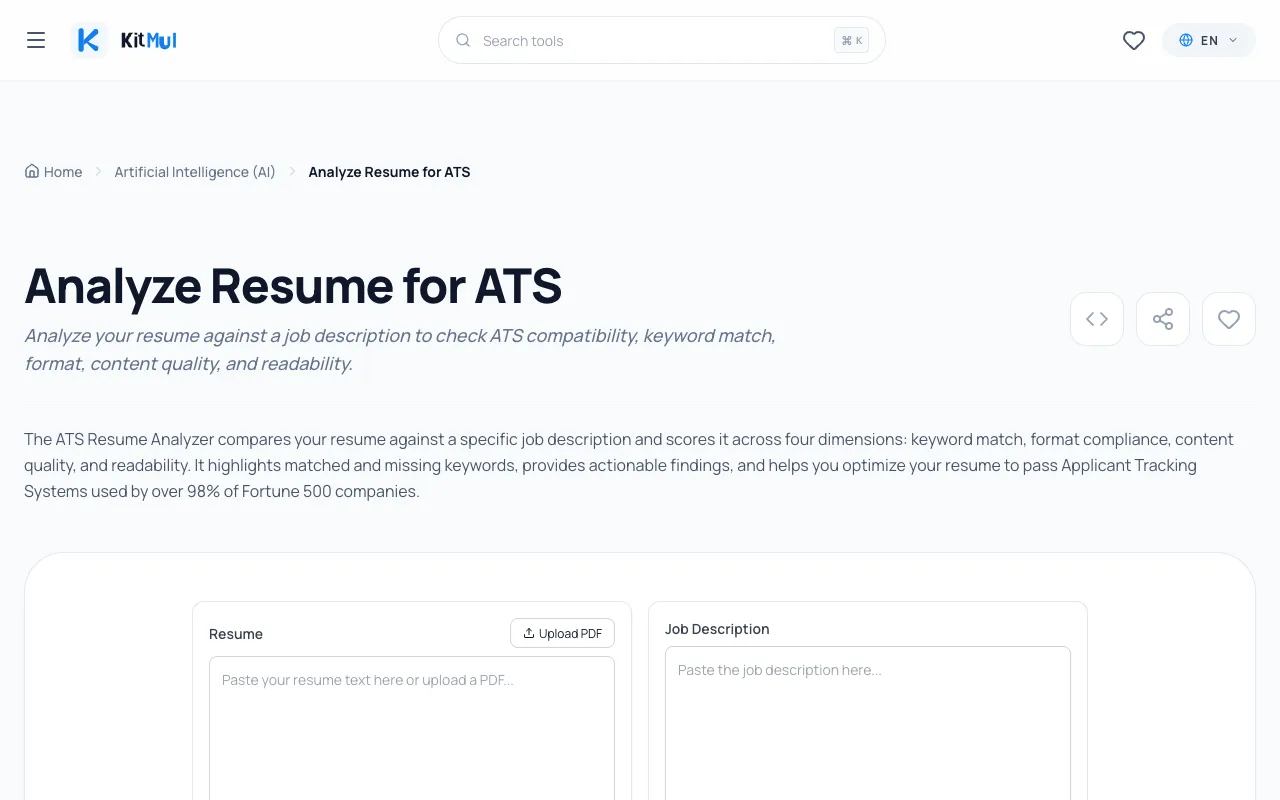
1. Run your resume through an ATS analyzer before submitting. Seriously. Paste your resume and the job description into a tool that scores keyword match, format compliance, and readability. You'll see exactly what's missing. The ATS Resume Analyzer scores your resume across four dimensions and highlights both matched and missing keywords; it runs entirely in your browser, so your resume never leaves your device.
2. Use a single-column layout. No tables, no text boxes, no columns, no headers/footers. Top-to-bottom, left-to-right. This isn't about aesthetics; it's about parser compatibility. Harvard's resume guide recommends this exact approach.
3. Save as PDF unless the application specifically requests DOCX. PDFs preserve formatting across systems. But make sure the PDF contains actual text, not a scanned image. If you can select and copy text from your PDF, you're fine. If not, the ATS will get nothing.
4. Tailor every application. The era of one resume for every job is over. Each job description uses different keywords, prioritizes different skills, and emphasizes different qualifications. A resume that scores 85% match for one role might score 45% for a similar role at a different company because the terminology differs.
5. Check your file name. Some ATS platforms use the filename for initial categorization. "Resume-Jane-Doe-Product-Manager.pdf" is better than "resume_final_v3_FINAL.pdf." This seems trivial, but recruiters who review hundreds of resumes notice.
The systems behind the curtain
The major ATS vendors; Workday, Greenhouse, Lever, iCIMS, Taleo (Oracle), and SuccessFactors (SAP); each parse resumes differently. What works perfectly in Greenhouse might partially fail in Taleo. There's no universal standard for resume parsing because there's no universal standard for how people format resumes.
Lever's documentation describes their parsing as "AI-powered," but in practice it still struggles with non-standard layouts. Greenhouse uses a combination of text extraction and machine learning, but their accuracy varies by file format. The point isn't to memorize each vendor's quirks; it's to understand that the safe path (simple formatting, explicit keywords, standard sections) works across all of them.
According to the Society for Human Resource Management, the average corporate job opening receives 250 applications. A recruiter spends an average of 7.4 seconds reviewing a resume that makes it past the ATS. Your resume has to survive algorithmic screening and then communicate value in under 10 seconds. Those are two fundamentally different challenges that require two different optimization strategies.
The bigger picture
ATS-driven hiring is a symptom of a larger shift: the automation of gatekeeping functions that used to be human. Search algorithms decide what information you see. Credit scoring models decide whether you get a loan. And resume parsers decide whether a human ever reads your application.
The common thread is that these systems optimize for efficiency at the cost of nuance. An ATS can process 10,000 applications in minutes; a human team can't. But the ATS also can't read between the lines, recognize unconventional career paths, or evaluate potential. The Harvard "Hidden Workers" report documented how millions of qualified workers are systematically filtered out by rigid automated criteria.
Understanding how these systems work doesn't guarantee you'll beat them. But it shifts the odds. Format your resume for the parser. Write your content for the human. Test before you submit. The gap between a qualified candidate and a visible candidate is often just formatting and keywords.
Complete guide
For a detailed walkthrough on scoring your resume, interpreting results, and optimizing for specific ATS platforms, see the Complete Guide to ATS Resume Analysis.
Privacy: Every tool on Kitmul runs entirely in your browser. No data is sent to any server. No account required. No tracking beyond basic analytics.